
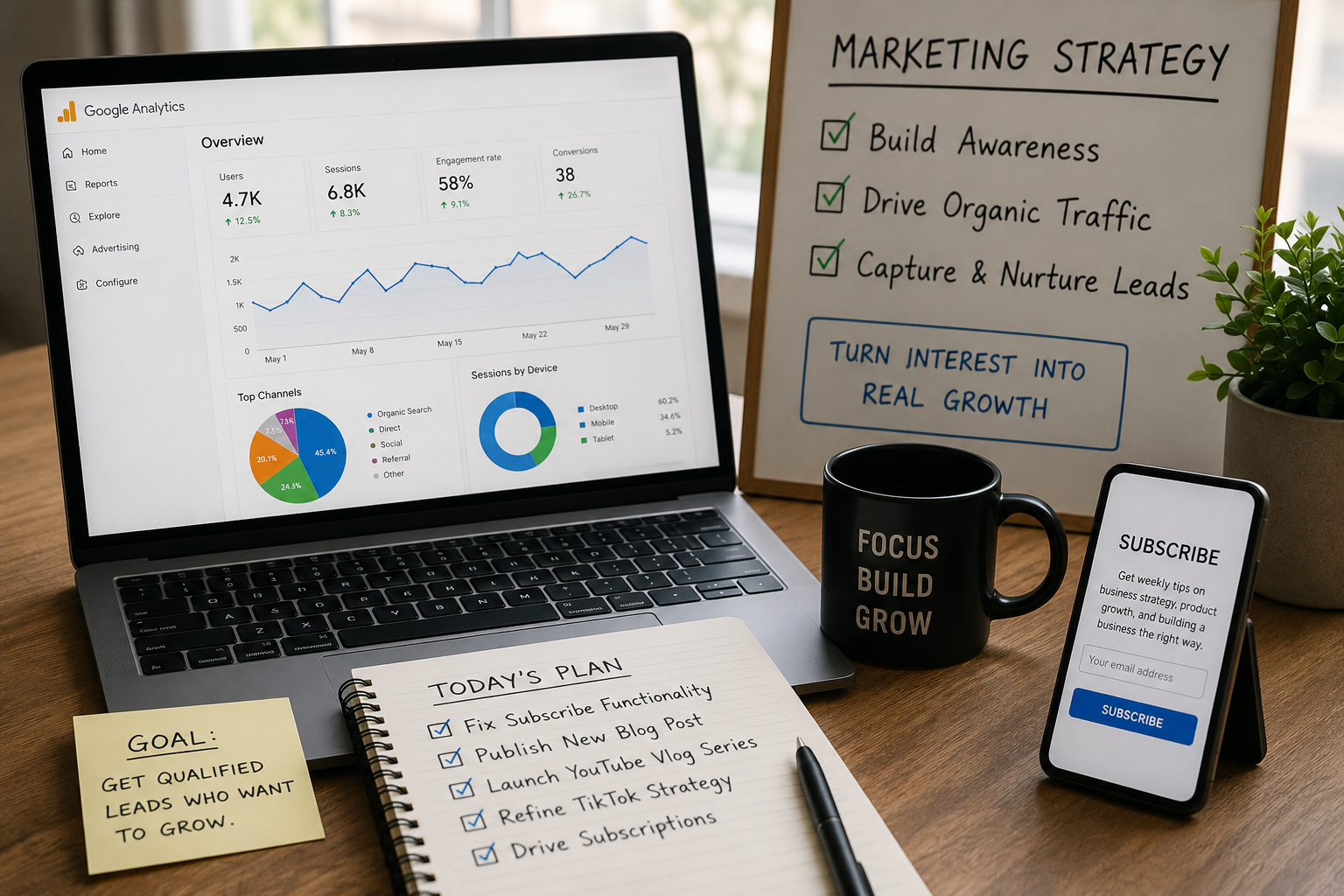
A lot of founders spend months building something, publish a few social media posts, and then become frustrated when people do not immediately visit the website, fill out a form, subscribe, or make a purchase.
The problem is not always the product.
Sometimes, the business has not created a clear system for turning awareness into measurable customer interest.
## Do Not Build A Perfect Product Without Customer Feedback
Whenever I build a product, I do not try to make it completely finished or perfect before real customers have interacted with it.
The early goal is not perfection.
The early goal is to validate demand, observe how people respond, and begin collecting real customer feedback.
Without customer feedback, founders are often making decisions based on assumptions. They may spend time building features, redesigning pages, or expanding the product before confirming that anyone actually wants the core solution.
A better approach is to launch a usable version, measure what happens, and allow customer behavior to guide the next iteration.
## Website Traffic Is Only The First Signal
One useful tool for understanding website activity is [Google Analytics](https://analytics.google.com/).
Google Analytics can help you monitor traffic, sessions, engagement, traffic sources, and how visitors move through your website.
That information is valuable because it helps answer an important first question:
Are people actually reaching the website?
However, traffic alone does not prove that people are interested in your product.
Someone can visit a page and leave without taking action.
That is why I wanted to measure something more specific for both XBiz Intelligence and Atlanta Local.
I wanted to know whether visitors were showing actual interest.
## Track Actions That Represent Real Interest
For our products, we added interest forms to the website and began tracking the sessions connected to those interactions.
The goal was to measure whether people were doing more than simply visiting a page.
Were they filling out the form?
Were they requesting more information?
Were they subscribing?
Were they taking a step that suggested they might become a customer?
The early data showed us something important.
We were not yet getting enough people to complete the forms, and we were not generating enough overall website traffic to properly evaluate demand.
Our social media engagement may have looked positive, but that engagement was not consistently turning into website activity or qualified leads.
That meant the next priority was not adding more features.
The next priority was improving the marketing system.
## Social Media Engagement Is Not The Final Goal
It is easy to become focused on views, likes, comments, and reach.
Those numbers can be useful, but they are not the final business objective.
For XBiz Intelligence, our real marketing goal is to attract qualified leads who are interested in launching a business, developing a product, improving customer acquisition, or learning how to grow more strategically.
We want those people to visit our website, access useful resources, and subscribe to our email list.
That subscription gives us a direct way to continue helping them, sharing useful information, and building a relationship over time.
This required us to take a step back and rethink how our content works together.
## Build The Marketing System Before Chasing More Reach
Today, one of our biggest wins was completing the subscription functionality for XBiz Intelligence.
Now, when someone finds our content and wants more business strategy, product development, marketing, or customer acquisition guidance, they have a clear next step.
They can subscribe.
We also began rebuilding the blog into a central part of the marketing system.
Instead of trying to explain an entire business strategy inside one short TikTok video, we can publish a detailed resource on our website and use social media to introduce the idea.
The blog becomes the main educational asset.
TikTok, Instagram, LinkedIn, YouTube, and other platforms become distribution channels that help the right people discover that asset.
We also started developing a long-form YouTube vlog series so people can follow the real journey of building, launching, testing, and marketing our products.
Each platform now has a clearer role.
The blog provides the detailed strategy.
YouTube documents the longer journey.
Short-form social media introduces the lesson.
The email list allows us to continue the relationship.
## Use Social Media To Drive Qualified Traffic
Our TikTok strategy is no longer just about reaching as many people as possible.
The goal is to reach the right people.
Someone who is serious about launching a product or business may find a short video explaining why their social media posts are not producing customers.
That video can introduce the problem and direct them to a detailed article on our website.
The article can help them understand how to:
- Validate demand.
- Measure website traffic.
- Track customer interest.
- Improve customer acquisition.
- Create stronger marketing systems.
- Build an email list.
- Turn content into qualified leads.
At the end, the reader has a clear choice.
If this is information they need, they can subscribe and receive more guidance each week.
That is a much stronger business strategy than publishing disconnected social media posts and hoping customers eventually appear.
## Awareness Must Lead Somewhere
The same strategy will be applied to Atlanta Local.
We need more people throughout Atlanta to know that the platform exists.
That means increasing awareness through social media, email outreach, flyers, in-person events, partnerships, and direct community engagement.
But awareness must lead somewhere.
Potential users need a clear reason to visit the website.
Business owners need a clear reason to submit their information.
Residents need a clear reason to subscribe.
Potential partners need a clear way to express interest.
Every marketing activity should move people toward a measurable next step.
## Show The Real Process
One of the most valuable parts of building Atlanta Local in public is that people have been able to follow the process.
They saw the early product development.
Now they can follow the next stage: attracting users, generating awareness, collecting feedback, and improving the product based on real behavior.
This allows us to do more than simply tell founders how to market a business.
We can show the actual process using a product we developed internally.
That includes the wins, the slow periods, the data, the adjustments, and the lessons we learn along the way.
## The Real Goal After Launch
After launching, your first goal should not be to make the product perfect.
Your goal should be to create enough awareness to generate traffic, give visitors a clear action to take, measure those actions, and use the results to improve both the product and the marketing strategy.
A strong early customer acquisition system should help you answer:
- Are people discovering the business?
- Are they visiting the website?
- Are they showing real interest?
- Are they subscribing?
- Are they requesting information?
- Are they becoming customers?
- What feedback are they providing?
Those answers are more valuable than assumptions.
Launching is the beginning.
The next stage is learning how to consistently turn attention into traffic, traffic into interest, interest into relationships, and relationships into customers.
If you are serious about launching a business or product and want weekly guidance on how to build, market, validate, and grow it the right way, subscribe to the XBiz Intelligence email list and follow the journey.
The Real Challenge
Building products, startups, and technology companies is rarely a straight path. Most founders spend far more time navigating uncertainty than celebrating wins. The challenge is not simply having a great idea. The challenge is consistently executing, learning, adapting, and continuing to move forward when the outcome is still unknown.
What We Have Learned
Sustainable growth comes from action, not perfection. Whether we're launching a new product, testing a business idea, improving internal systems, or experimenting with new technology, the goal is always the same: learn quickly, improve continuously, and build solutions that create real value. Every project, success, and setback becomes data that helps us make better decisions moving forward.